The sun doesn’t have to feel hot to do damage
Make these five sun-smart habits part of everyday life.
Saturday afternoon on the Central Coast.
The Morgan family is heading to the beach. It’s mild and partly cloudy, with a lovely sea breeze.
Towels, snacks, water bottles. Check.
But Lex has forgotten his hat.
One of the kids can’t find their sunglasses.
And where’s the sunscreen?
The Central Coast is a melanoma hotspot
Two in three Australians will develop skin cancer during their lifetime. Yet most skin cancers can be prevented.
According to Cancer Institute NSW, the Central Coast ranks fourth among NSW local health districts for melanoma incidence.
More than 95 percent of skin cancers are caused by exposure to ultraviolet (UV) radiation.
Cloudy with a chance of skin damage
Here’s something many Australians don’t realise: the sun produces both heat and UV radiation. While we can feel warmth, we can’t feel UV damaging our skin.
That means a mild, partly cloudy day can still carry a high risk of sunburn and skin cancer.
Clouds don’t necessarily block UV. And a cool sea breeze can make a high-UV day feel deceptively pleasant.
What is the UV Index?
The UV Index measures the strength of ultraviolet radiation reaching Earth’s surface. The higher the number, the greater the potential for skin and eye damage.
A UV Index of 3–5 is moderate, 6–7 is high, 8–10 is very high, and 11 or above is extreme.
On the Central Coast, UV levels can be high even when the weather feels cool. Sun protection is recommended whenever the UV Index reaches 3 or above.
But you don’t need to check the forecast every time you head outside. Making sun protection routine is an easy way to stay prepared.
Five ways to protect your skin
Remember Sid the Seagull and Slip, Slop, Slap?
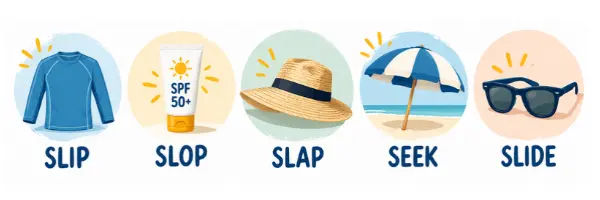
That catchy campaign now includes two extra steps:
- SLIP on sun-protective clothing.
- SLOP on broad-spectrum, water-resistant SPF50+ sunscreen. Apply 20 minutes before going outside and reapply every two hours, or after swimming or sweating.
- SLAP on a broad-brimmed hat that protects your face, ears and neck.
- SEEK shade. Keep a beach umbrella in the car and you can bring your own shade.
- SLIDE on sunglasses that meet Australian standards.
Make it easy for the whole family
The secret is to make sun protection as automatic as grabbing your car keys.
Keep sunscreen by the front door and another bottle in the swimming bag. Store spare hats and sunglasses where you’ll need them. Keep an umbrella in the boot.
And get familiar with your skin. If you notice a new, changing or unusual spot, or a sore that won’t heal, see your GP.
Making it clockwork
Everyone has one thing to remember.
Scarlet reaches for the sunscreen by the front door. Lex remembers the spare hat in the beach bag, and the missing sunglasses? There’s a backup pair tucked into the car visor.
The beach umbrella is already in the boot.
Five minutes later, they’re on their way. Another afternoon enjoying the beach. Like clockwork.
References and further information
Cancer Council Australia – National Skin Cancer Action Week 2026
Confirms 15–22 November 2026, the two-in-three Australians statistic, the five Ss and the importance of lifelong sun protection habits.
Cancer Institute NSW – Know the NSW melanoma hotspots
Confirms the Central Coast ranks fourth among NSW local health districts for melanoma incidence and 23rd among local government areas.
Cancer Council Australia – UV: Skin damage you can’t see
Particularly valuable for your central message. Explains the difference between infrared radiation (heat) and UV radiation, and why cool or cloudy weather doesn’t mean low UV.
Bureau of Meteorology – About the UV Index
Authoritative explanation of UV levels, the five UV categories and why temperature isn’t a reliable indicator of UV exposure.
Cancer Council Australia – Skin cancer causes, symptoms and risks
Supports the statistic that more than 95% of skin cancers are caused by UV exposure, and the advice to recognise skin changes.
This article provides general health information only and is not a substitute for personalised medical advice, diagnosis or treatment. If you have concerns about your skin, including new or changing spots, please consult your GP or another appropriately qualified healthcare professional.