
Decembeard and Decembhair?
Drumming up some action on Bowel Cancer
If you’ve noticed a surge in luxurious facial hair around the Central Coast each December, you’re not imagining it. It’s Decembeard (and, increasingly, Decembhair), a month-long campaign by Bowel Cancer Australia encouraging Australians to grow, show, or support hair to raise awareness of bowel cancer.
Yes — it’s the one time of year when sporting a magnificent beard or bold new hairstyle can legitimately be called a public health contribution.
But behind the fun is a serious Aussie health issue that affects both men and women. Statistics from Cancer Australia find 47 percent of cases are in women. And it’s not only older people.
Why Bowel Cancer Needs the Spotlight
Bowel cancer (also called colorectal cancer) is one of the most diagnosed cancers in Australia. Around 5,235 people have died from bowel cancer in Australia this year, says Cancer Australia. While men have a slightly higher risk overall, women account for thousands of diagnoses every year too.
The risk increases with age — especially after 50 — which is why the free National Bowel Cancer Screening Program sends out test kits for people aged 50–74. You can also request the free test if you’re over 45.
And yes, it really is one of the most effective health screening tools we have in this country. Simple. Private. Free. Mailed to your door. No excuses left, really.
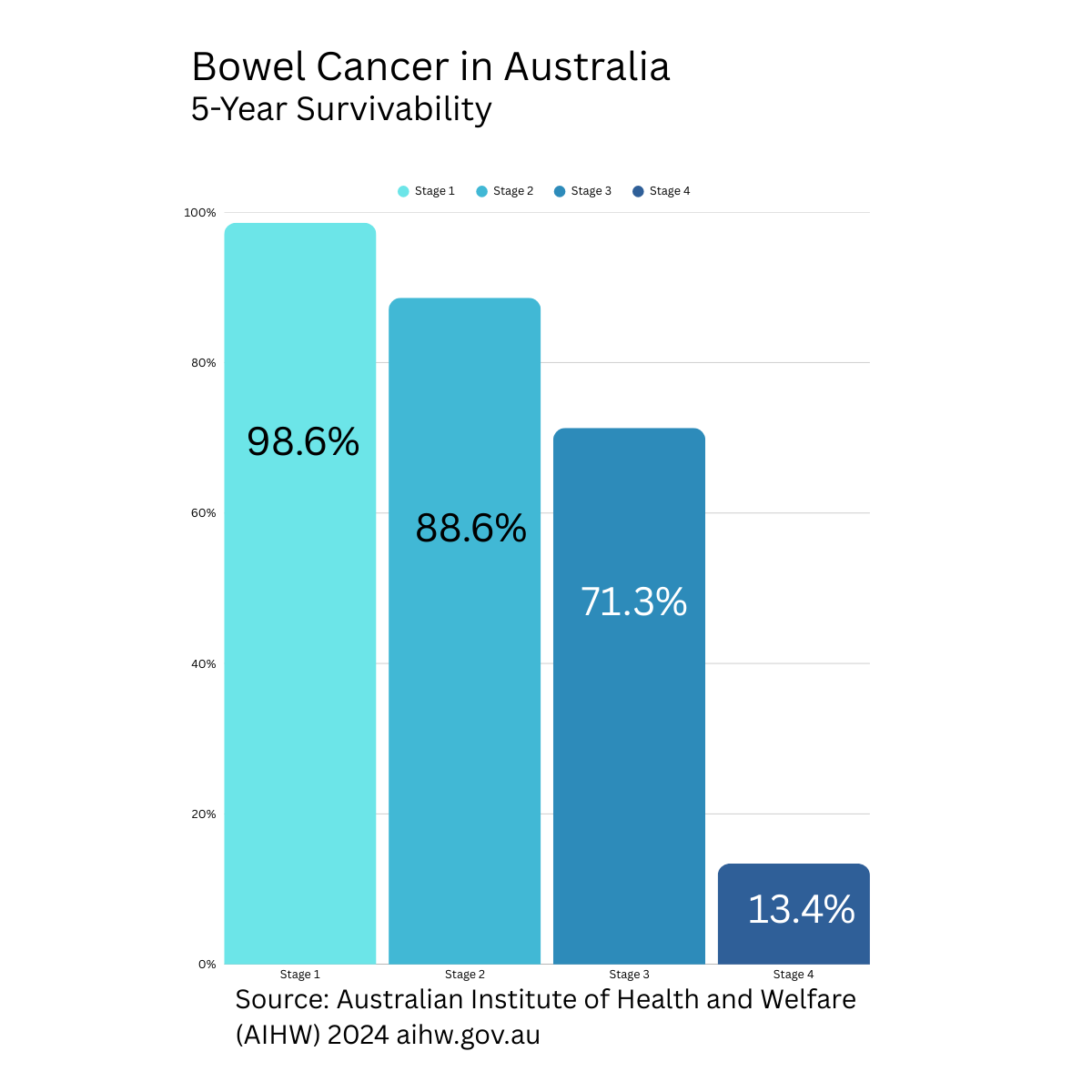
Screening methods, like the National Bowel Cancer Screening Program (NBCSP) home test (FOBT), detect cancer much earlier than waiting for symptoms.
- Screen-Detected Cancers: Patients with screen-detected cancers are significantly more likely to be diagnosed at a less advanced stage (Stage I or II) than patients diagnosed after presenting with symptoms.
- The problem is only about 41.7% of eligible Australians are doing the free test.

A Social Story: Tony and the Norse Beard of Destiny
Tony*, aged 51, has what can only be described as a Norse-god-level beard — the sort of beard you’d expect to see wielding a hammer or summoning lightning.
This December, Tony decided to lean into the theme and give Decembeard his full support. He’d received his free bowel screening kit in the post a few months earlier, and it had been staring at him from the bathroom cabinet ever since.
One Saturday morning, he finally said, “Right — time to sort this out,” and did his FOBT test. When his result came back positive for blood, Tony felt that thud-in-the-gut feeling most people get with unexpected health news.
His GP explained that a positive test doesn’t mean cancer — just that blood was detected, and he needed a follow-up colonoscopy to check things properly. The colonoscopist removed the polyp during the procedure. No radiation or chemotherapy was needed. Tony and his beard returned to normal life.
For Tony, the biggest lesson was simple:
The test was easy. Ignoring it would’ve been much harder in the long run.
(*This story is illustrative only and does not depict a real patient.)
Bowel Cancer: What You Need to Know
Bowel cancer happens when abnormal cells grow in the colon or rectum. It often starts as a small polyp — a tiny lump that can usually be removed before it ever turns into cancer.
The tricky bit? You can have bowel cancer without any symptoms at all.
When symptoms do appear, they can include:
- Blood in your poo
- Unexplained weight loss
- Ongoing abdominal pain
- Persistent changes in bowel habits
- Fatigue or anaemia
These symptoms can be caused by things other than cancer, but they’re always worth checking with your GP.
A Quick Word on Women and Bowel Cancer
Because Decembeard is often seen as a men’s month, women sometimes miss the message — but they shouldn’t.
Women on the Central Coast are diagnosed with bowel cancer every year. The screening program is for all genders aged 50–74, and women should take the test just as seriously as men.
Decembhair — a newer companion campaign — encourages women to participate by styling, colouring or celebrating their hair in any form (even eyebrows count).
The message is the same: raise awareness, normalise screening, and start conversations.
Why Early Detection Matters
According to Bowel Cancer Australia, when bowel cancer is found early, around 90 per cent of people can be successfully treated.
That percentage drops significantly if the diagnosis happens later.
That little test kit in the mail? It really can make all the difference.
How Much Does Bowel Cancer Affect Australia?
Using reputable Australian sources such as the Australian Institute of Health and Welfare (AIHW) and Cancer Australia:
- Men have slightly higher rates of diagnosis, but thousands of women are diagnosed each year.
- Around 1 in 15 Australians will develop bowel cancer in their lifetime.
- It’s one of the leading causes of cancer death — but also one of the most treatable when caught early.
These stats are precisely why Decembeard exists. Awareness saves lives — and sometimes also produces excellent beard content.
On the Central Coast
Local GPs, screening clinics and specialists are well-equipped to help with:
- Completing your bowel screening
- Interpreting results
- Arranging colonoscopy referrals
- Managing bowel symptoms
- Offering lifestyle advice to reduce risk (diet, activity, smoking cessation, alcohol reduction)
If your test comes back positive, your GP will guide you through the next steps — and it doesn’t automatically mean cancer.
This December, Let the Hair Do the Talking
Whether you’re sporting:
- A beard
- A mo
- A fresh mullet
- A bold fringe
- Or simply a proud pair of eyebrows
…you’re helping shine a light on a health condition that affects many Central Coast locals every year.
Do the test. Encourage your mates. Have the conversation.
And if you’re feeling brave — grow something impressive.
For further information
Bowel Cancer statistics in Australia – https://www.canceraustralia.gov.au/cancer-types/bowel-cancer/bowel-cancer-colorectal-cancer-australia-statistics
Central Coast Cancer Services – https://www.cclhd.health.nsw.gov.au/services/central-coast-cancer-services/cancer-services/
Health Direct – Bowel Cancer information
Decembeard – Bowel Cancer Australia
Narara Valley Medical – book a doctor’s appointment
This article is general information only and isn’t intended to be medical advice. Please see your doctor for the advice that’s right for you.