
Is your Thyroid Secretly Running the Show?
Tired, wired, or just confused? You may have an issue with your thyroid.
What Is the Thyroid?
The thyroid is a small, butterfly-shaped gland that sits at the front of your neck, just below your voice box. Even though it’s small, it has a huge job: it makes hormones that control your body’s metabolism.
This means the thyroid helps manage:
- How fast or slow your body uses energy
- Your body temperature
- Your heart rate
- How your brain and organs develop
The problem is that many of us don’t even think about our thyroid and often don’t realise when it’s a problem.
Thyroid issues affect ten times more women than men. Australian Thyroid Foundation estimates that one million Australians currently have a thyroid disorder that is undiagnosed.
May is Thyroid Awareness Month.
When your thyroid isn’t working properly, it can affect every part of your body. If you’re pregnant or planning to be, it can also affect your baby.
Why is the thyroid so important for pregnancy?
During pregnancy, your body needs to make extra thyroid hormones to support your growing baby — especially in the first 12 weeks, when your baby’s own thyroid hasn’t developed yet.
If you don’t have enough thyroid hormones while you’re pregnant, it can cause serious problems, including:
- Miscarriage or stillbirth
- Premature birth
- Low birth weight
- Poor brain development (leading to learning difficulties later)
- Hearing and speech problems in the baby
Even mild thyroid problems, if left untreated, can lower your child’s learning ability. That’s why keeping your thyroid healthy is so important before and during pregnancy.
How does iodine fit in?
Iodine is a mineral your thyroid needs to make thyroid hormones.
If you don’t get enough iodine, your thyroid can’t do its job properly.
During pregnancy, your need for iodine goes up by about 50 percent. It’s very hard to get enough just from diet alone, so many health experts recommend a pregnancy supplement with iodine. The National Health and Medical Research Council recommends taking a supplement of 150 micrograms each day in addition to healthy eating.
“Iodine deficiency is the most common preventable cause of intellectual disability in the world,” Nutrition Australia
Food sources of iodine
You can get iodine naturally from food. Here’s where to find it:
Best sources:
- Seafood (like fish, prawns, seaweed)
- Dairy products (milk, cheese, yogurt)
- Eggs
- Iodised salt (salt with iodine added — check the label)
For vegans and vegetarians:
- Seaweed (like nori, wakame, and kelp) is very high in iodine (be aware that too much can also be harmful)
- Iodised salt is a safe and easy option for most people
- Some plant milks (like soy or almond milk) may be iodine-fortified — check the nutrition label.
If you’re vegan, talk to your doctor or dietitian about whether you need an iodine supplement.
Thyroid issues can affects any age. They are estimated to affect one million Australians without them realising. Women are ten times more likely
Thyroid Disorders
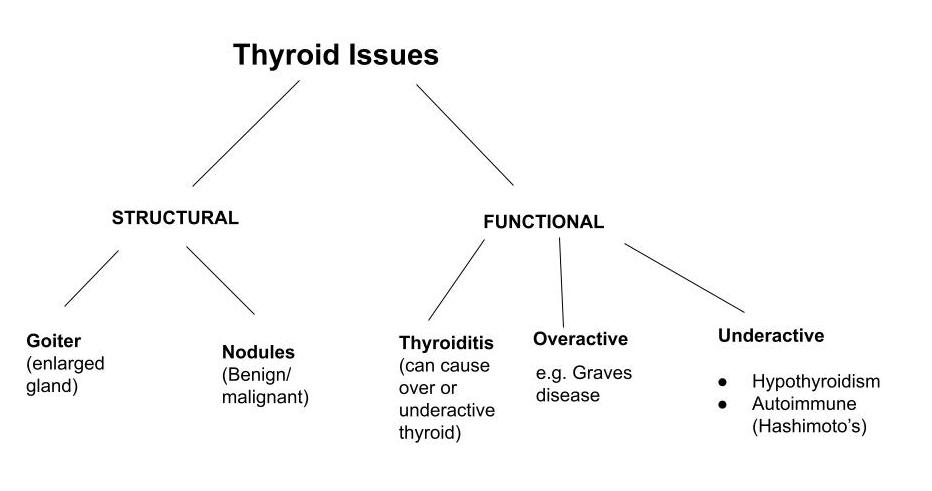
Above: Sketch of common thyroid disorders. Source: Narara Valley Medical
Goiter
Goiter (or goitre) is a swelling of the thyroid gland in the neck. It can be due to several reasons and may be painful or not. It will feel smooth to the skin. Ask for a GP to check.
Thyroiditis
Thyroiditis is an inflamed thyroid. The inflammation can cause underactivity or overactivity.
Graves’ Disease
Graves’ disease is an autoimmune disorder where the immune system mistakenly stimulates the thyroid, causing it to produce too much hormone — leading to hyperthyroidism. This results in symptoms like rapid heartbeat, weight loss, heat intolerance, nervousness, and bulging eyes (known as Graves’ eye disease).
Hashimoto’s Disease
Hashimoto’s disease is an autoimmune condition where the immune system attacks the thyroid gland. Over time, this damages the thyroid, making it underactive — a condition known as hypothyroidism.
Hypothyroidism
This is an underactive thyroid. The gland is not able to produce enough of the thyroid hormones the body needs.
What to watch for
Thyroid problems are common, especially in women. Some signs your thyroid might not be working well include:
- Feeling unusually tired
- Gaining or losing weight without trying
- Feeling cold all the time
- Feeling anxious or irritable
- Trouble getting pregnant
- Changes in your periods
If you notice these symptoms, it’s important to talk to your GP. A simple blood test can check how your thyroid is working.
To check your thyroid, book an appointment with your GP
If you are concerned about their thyroid, the best first step is to book an appointment at Narara Valley Medical.
The doctor will usually:
- Listen to your symptoms (like tiredness, weight changes, feeling hot or cold, mood changes, or changes in your skin or hair).
- Feel your neck to check for any swelling or lumps around the thyroid.
- Order blood tests to check your thyroid hormone levels (usually TSH, T3, and T4) and sometimes test for thyroid antibodies if an autoimmune condition is suspected.
Depending on the results, your GP might:
- Start treatment (like medication if needed)
- You may receive a referral to an endocrinologist (a hormone specialist) if further help is required.